
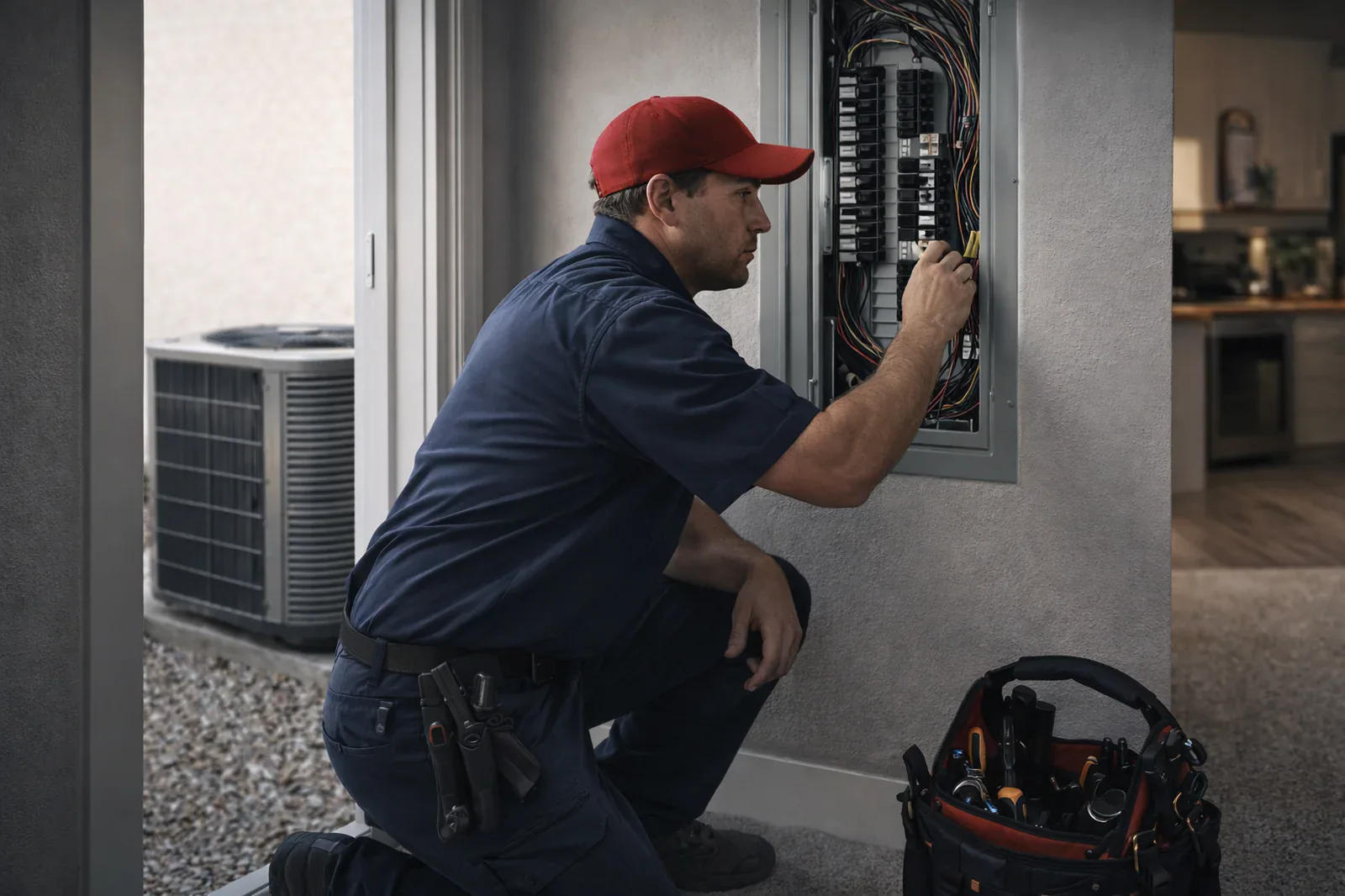
You know that moment when you finally get home to the Mornington Peninsula, kick your shoes off, tap “cool”, and your whole house goes dark? One second you feel like a fully‑functioning adult. Next second, you stand at the switchboard, bargaining with a tiny plastic lever.
When your HVAC keeps Tripping the circuit breaker, I want you to treat it like your phone throwing an overheat warning. Your breaker doesn’t do drama for attention. It trips because it spots too much electrical current (power draw) or a fault that could damage wiring, your system, or both.
If you want a local, no‑nonsense fix, I’d start with a chat to a home climate control specialist who understands Peninsula homes (old beach houses, new builds, and everything in between).
I see a lot of Tripping around the Peninsula for two very real reasons: coastal air that loves chewing on outdoor units, and modern life that stacks loads on your switchboard (induction cooking, dryers, EV charging, you name it).
Before you blame the air con, I want you to know one thing: people often call any trip “the breaker.” Your switchboard may trip a circuit breaker (overload/short circuit) or a safety switch/RCD when electricity leaks where it shouldn’t. The fix changes depending on which one trips, so I always confirm what actually flipped.
I also want you to resist the urge to reset the breaker over and over like you’re swiping “refresh” on a slow app. Repeated Tripping can damage pricey components (especially the compressor), and it can hide a genuine safety issue.
So I start with a simple question: when does it trip? If it trips instantly on start-up, I suspect a start-up strain (capacitor, compressor, or a dodgy connection). If it trips after a few minutes, I suspect overheating, restricted airflow, or a motor that draws more power as it warms.
And if Tripping only shows up after rain, heavy humidity, or salty sea spray, I look at moisture. Water plus electricity equals trouble. Add salt and you invite corrosion, which can slowly mess with connections and insulation.
Why your HVAC trips the breaker
I think of your HVAC like a high-performance espresso machine: it needs a quick hit of energy to start, then it settles into a steady run. When something makes the system work harder than normal, it pulls extra current. Your breaker reacts and cuts power to prevent overheating.
I bucket most causes into three themes: too much load, too much effort, or too much fault.
Too much load: the circuit carries more than it can handle (for example, your HVAC shares a circuit with other big appliances).
Too much effort: your HVAC struggles because airflow or heat transfer drops (dirty filter, blocked vents, clogged coils, jammed fan).
Too much fault: a component or wire misbehaves (short circuit, failing capacitor, moisture inside electrics, failing motor windings).
Quick tip I use in almost every call-out: I check whether your HVAC runs on a dedicated circuit. Bigger systems usually want their own breaker, not a shared “catch‑all” circuit that also feeds power points, fridges, or garage gear.
When you share, you can trip the breaker during peak use even if the air con itself works fine. A tech can confirm correct breaker size by matching the switchboard rating to the numbers on the unit’s data label.
The most common Mornington Peninsula Tripping triggers
Dirty filter / blocked airflow
When airflow drops, motors work harder. You’ll often notice weak airflow, a musty smell, or rooms that never quite hit the set temp. If you search “air conditioner keeps Tripping breaker” and you also haven’t checked the filter in ages, start right there.
Outdoor unit can’t breathe
Your outdoor unit needs free airflow. Leaves, coastal grit, spider webs, and over‑enthusiastic landscaping can trap heat. That trapped heat makes the compressor run hotter and draws more power, so Tripping often happens after 3–10 minutes rather than instantly.
Insert image of: an outdoor condenser unit near a coastal garden with blocked fins and leaf debris.
Start-up strain (capacitor or compressor)
If Tripping hits the moment you start cooling or heating, a start-up component may struggle. The compressor tries to spin, draws a bigger surge than normal, and the breaker taps out.
Loose connection or tired breaker
Heat cycles can loosen connections in electrical gear over time. Breakers can also wear out. If you notice buzzing, heat at the switchboard, or a burnt smell, you need a licensed sparky quickly.
Moisture + corrosion
The Peninsula air can feel like a damp hoodie in winter, and ocean air carries salt. Moisture can creep into outdoor isolators and terminals. Corrosion can raise resistance and trigger faults, especially after rain.
Quick guide table—match the Tripping pattern to what it means
| When it trips | What it often hints at | Safe thing you can do now | Who to call |
|---|---|---|---|
| Instantly on start-up | Capacitor/start issue, compressor strain, short | Turn the system off; don’t keep resetting | HVAC tech (and sparky if wiring looks suspect) |
| After a few minutes | Overheating from dirty coils, blocked airflow, fan motor | Replace/clean filter; clear debris around outdoor unit | HVAC tech |
| Only during “high load” times | Circuit overload, voltage drop, weak breaker | Run HVAC without oven/dryer/EV charging for a test | Licensed electrician |
| After rain / high humidity | Moisture intrusion, corrosion, insulation breakdown | Keep it off; keep area dry | Licensed electrician + HVAC tech |
Mini decision flowchart (quick, not scary):
Breaker trips?
├─ Trips instantly when you start cooling/heating
│ ├─ Reset once only, then stop
│ └─ Book an HVAC tech to diagnose start-up components
├─ Runs for a bit, then trips
│ ├─ Check filter + clear outdoor airflow
│ └─ If it repeats, book an HVAC service
└─ Trips after rain / heavy humidity
└─ Keep it off and call a licensed electrician
A safe troubleshooting flow that won’t get you zapped
I’ll keep this strict: you can do visual checks and basic housekeeping, but you shouldn’t open panels or touch wiring.
First, I turn the HVAC off at the controller. I give it 5–10 minutes to cool down before I touch anything at the switchboard.
Second, I check for red flags. If you smell burning, hear loud buzzing, see scorch marks, or spot melted plastic, you stop and call a licensed electrician.
Third, I fix the easy airflow stuff. I changed the filter. I check that furniture and curtains don’t block return vents. I make sure indoor vents sit open.
Fourth, I clear space around the outdoor unit. I remove leaves and weeds. I keep hoses and sprinklers away from electrical parts.
Last, I ran a simple “load test.” I cool the house while other big appliances take a break. If Tripping stops, I treat it as a circuit capacity issue and I book an electrician to check the circuit, connections, and breaker condition.
Important rule: I stop after two trips. If it trips twice in one day, I book a pro. Repeated Tripping can damage the system.
In Victoria, I point people to Energy Safe Victoria’s household wiring guide because it explains, in plain terms, what breakers and safety switches do and why they trip.
Prevention that fits Peninsula life
I keep this simple and realistic.
I check filters regularly, especially in peak summer and winter.
I get a yearly service if I live close to the water, because salt speeds up corrosion.
I ask about coastal protection features when I replace a unit, because anti‑corrosion treatments can matter near the bay.
I don’t ignore the switchboard. A spark can tighten connections, check breaker health, and confirm the circuit matches the HVAC’s needs.
Conclusion
When your HVAC keeps tripping the circuit breaker, I treat it as a clue, not a curse. Sometimes you fix it with a clean filter and better airflow. Sometimes you need pro testing for capacitors, motors, compressor issues, moisture faults, or an overloaded circuit.
If you hit Tripping more than once, stop resetting, note when it happens, and book a licensed inspection. You’ll protect your system, your home, and your weekend plans.
